
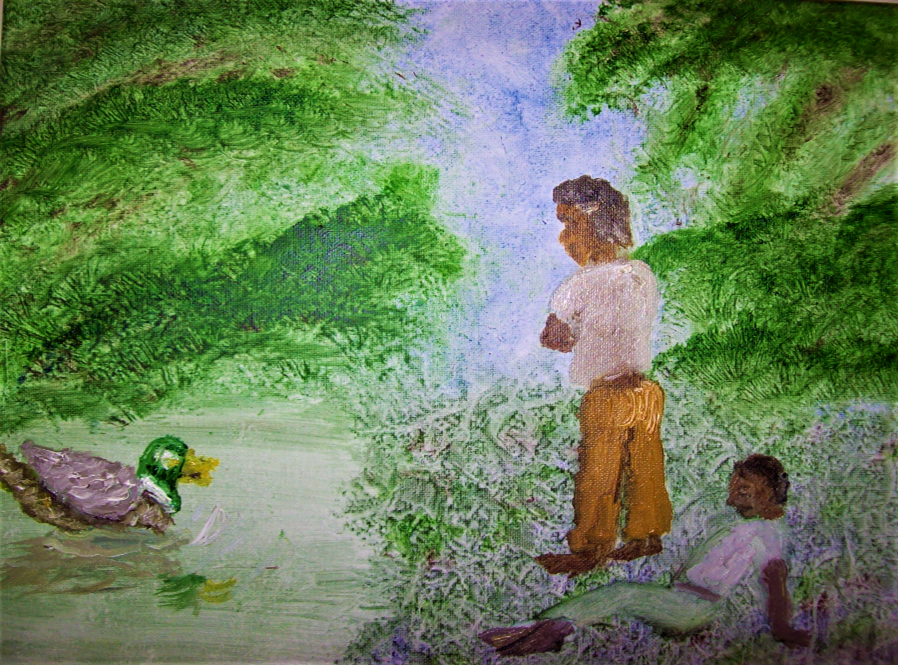
A man once took his son to the duck pond.
As they passed the geese, the geese chased the ducks into the water.
Geese are bigger and stronger, and the ducks stayed away.
To the boy, it seemed the geese were laughing with all that honking.
The father took out some bread to feed the ducks.
It didn’t take long for the geese to come and chase them off again.
The son tried to feed only the ducks, but the geese rushed in every time.
Still, one duck kept coming back and would not be deterred.
A goose honked loudly and repeatedly.
“What do you suppose that goose is saying?” the father asked, smiling.
“I suppose he’s telling the duck to go now,” the boy said,
“Or he’ll get him later.”
“Why doesn’t the duck leave then?” asked the father.
The boy answered, “Well… I’m trying to feed the duck.
And I think the duck knows the goose will chase him later no matter what he does now.”
He smiled too.
The father laughed and patted his son on the back.
“You are very observant,” he said.
They sat together and watched the ducks.
“The Duck Pond” is a fable from my book, Freedom at the Lake and Other Fables.
I wrote this little fable about something I think we all do.
Sometimes we spend so much time worrying about what might happen that we give something up before anything has even happened.
The duck seems to understand something we sometimes forget.
If the goose is going to chase you anyway, you might as well eat the bread.
Do it anyway.
Albert Jr.
Author of The Nature Within Us and Freedom at the Lake
Side Trails 🥚🎨
Leave a Reply